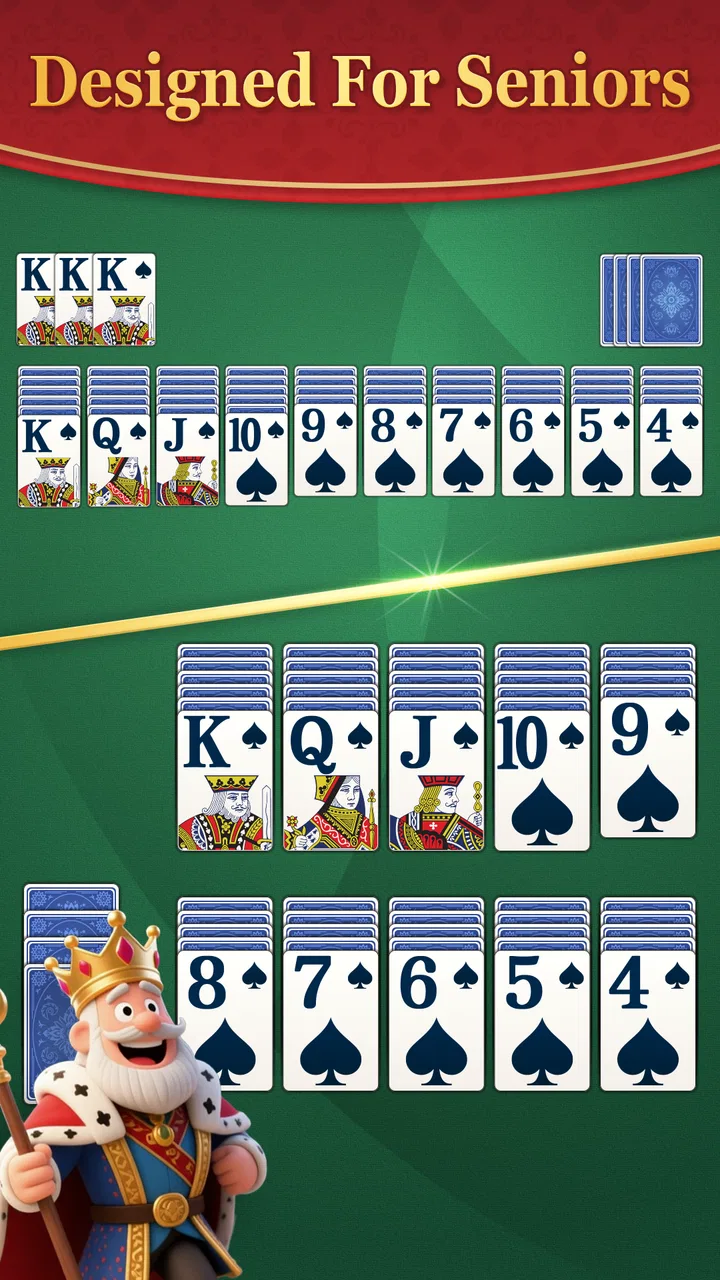
Spider Solitaire - Retro Card
- 5.0
- Rating
- 1.00M
- Installs
- Free
- Price

 Analysis by App-foxy
I have always liked card games that ask for attention without demanding my whole evening, and Spider Solitaire - Retro Card fits that mood well. It is a free card game from Worthy Journey, built around the familiar Spider Solitaire format rather than around a large collection of unrelated modes. After spending time with it, my impression is that its main appeal is simple: it gives me a quiet puzzle to return to when I want to think for a few minutes, but I do not want the pressure of a competitive match or the learning curve of a strategy game.
The important thing to understand is that this is a focused experience. The store identifies it simply as Spider Solitaire, and that straightforward identity is also its strength. I am not opening it for a story, social competition, or a complicated progression system. I am opening it to arrange cards, uncover hidden possibilities, and decide whether a difficult layout can be rescued. For players who enjoy that rhythm, the best reason to try it is its calm, repeatable form of mental exercise.
How the current version feels in everyday use
In its current form, version 1.7.5 presents itself as a compact, accessible way to play a classic card game. The app is listed as free, carries an Everyone age rating, and supports Android 7.0 or later. That combination makes it a practical choice for people using an older Android phone, as well as for anyone who wants a lightweight card game instead of a demanding modern title.
You May Also Like

 Pandora - Music & Podcasts
Pandora’s Music Is Easy to Start, but Harder to Recover
Pandora’s strength is its low-effort path from a seed to a station. Its weak spot is how much confidence it asks you to place in connection, setup, and quiet recovery.

 AccuWeather: Weather Radar
AccuWeather Review: A Quick, Clear Forecast for Everyday Decisions
For everyday plans, the best forecast is the one you can understand quickly. AccuWeather makes rain timing, radar, and local conditions easy to act on, with a few trade-offs.

 Hill Climb Racing
Why Hill Climb Racing Still Turns Crashes Into One More Run
A tiny car, a bumpy hill and one more upgrade: Hill Climb Racing keeps resurfacing because its simple chaos makes every near-miss feel personal.

 AliExpress - Shopping App
AliExpress Makes Global Shopping Feel Personal, but Shoppers Bear the Risk
AliExpress turns a global marketplace into a pocket-sized discovery engine. Its reach is useful, its shopping loop compelling, and its trade-offs easy to miss.

 Lords Mobile: Kingdom Wars
Lords Mobile Is a Kingdom-Building Routine, Not a Quick Match
A case-by-case verdict on the building, battles, device demands, and social commitments that make Lords Mobile rewarding for some players and exhausting for others.

 PDF Scanner app - TapScanner
TapScanner Makes Paperwork Easier to Capture, Check, and Share
TapScanner makes scanning with a phone feel less like a rescue operation and more like a dependable step in getting work done. Its capture tools are useful, though not flawless.
More From Our News Desk
View All News


I find the format particularly suitable for short breaks. A game can fit into the gap before an appointment, during a commute when I am sitting still, or at the end of the day when I want something more engaging than scrolling. It does not require me to coordinate with another person, wait for a match, or remember a complex set of controls. The attention goes almost entirely toward the layout in front of me.
That simplicity should not be confused with a lack of depth. Spider Solitaire is easy to understand at a basic level, but good decisions become less obvious as the tableau develops. Moving a sequence may reveal a useful card, yet it may also remove the only temporary space available for another maneuver. I often find myself planning two or three moves ahead, especially when several columns are partly blocked.
The app has earned a 4.9 average from around one thousand ratings, and it has passed over one hundred thousand installs. Those figures suggest that the straightforward approach is connecting with a sizeable audience. They do not replace personal experience, but they do match what I noticed: this is designed to be approachable rather than intimidating.
The familiar rules are the real starting point
Anyone who already knows Spider Solitaire can get into a game quickly. The goal is not to learn an original card system but to work within the familiar challenge of building ordered runs and clearing the tableau. That makes the app especially friendly to people who have played the game on a computer, with physical cards, or through another mobile version.
For a new player, the first useful habit is to resist making the most obvious move immediately. I try to look across every column before touching a card. A move that opens a hidden card is usually more valuable than one that merely creates a neat-looking sequence. I also keep track of which columns can become empty, because an open column acts like a temporary work area and can completely change the puzzle.
One of the less obvious lessons is that a long sequence is not always a good sequence. It can be tempting to stack cards simply because they fit, but a mixed or awkward arrangement may become difficult to move later. I prefer to preserve flexibility until I know which column I want to use as a workspace. That small change in approach makes the game feel less like random tapping and more like a deliberate puzzle.
This is also where the retro character matters. The appeal is not visual spectacle; it is the recognizable card-table feeling. Players who want a quiet, old-fashioned solitaire session will probably appreciate that focus. Someone expecting animated rewards, a large adventure layer, or a constantly changing set of challenges may find the presentation too restrained.
Why it works well for short breaks
A realistic use case is a ten-minute pause between tasks. I can start a layout, make a few careful moves, and stop without feeling that I have abandoned a team or interrupted a live contest. That makes it different from online card games, where leaving early may affect another player, and from many puzzle games that push daily objectives or timed events.
The same quality can be useful before sleep, although I would still pay attention to how stimulating any screen feels personally. The game gives my mind a narrow problem to solve, which can be more satisfying than aimless browsing. When I am tired, I can play conservatively and focus on clearing obvious sequences. When I am more alert, I can examine the consequences of moving a buried card too soon.
Another practical use is as a low-pressure concentration exercise. I would not describe it as a formal training tool, but it does encourage visual scanning, sequencing, and delayed decisions. The benefit comes from playing thoughtfully rather than tapping through quickly. If I rush, I create avoidable dead ends; if I pause and compare the columns, the same layout becomes much more manageable.
What the version and release history tell me
The game was released on December 11, 2025, and the current version is 1.7.5. That gives the app a relatively recent starting point while also showing that it has already moved beyond its initial release build. I see that as a sign of an actively maintained product rather than a one-time upload, although a version number alone does not tell me exactly which changes were made in each update.
It is useful to separate what can be observed from what I might hope to see later. The present experience is centered on the classic card format. I would welcome continued refinement around clarity, responsiveness, and ease of use, but I would not assume that a future update will add a particular feature. The current version should be judged on the focused game it offers now.
For existing users, moving to version 1.7.5 should be understood as staying with the same basic kind of experience rather than switching to a different game. The core appeal remains the ability to sit down and play Spider Solitaire without a complicated setup. That continuity is valuable for returning players who want their familiar routine preserved.
At the same time, returning users should avoid expecting every update to transform the app. A mature card format benefits from stability. If the controls feel natural and the layouts remain enjoyable, small improvements can matter more than dramatic additions. In my view, the developer’s challenge is to improve the edges without distracting from the card table.
Where the app is strongest
The biggest strength is its narrow purpose. There is very little mental overhead between deciding to play and actually studying the cards. I do not need to build a profile, understand a fictional world, or learn a new economy. The game is immediately recognizable, which makes it a good recommendation for a friend who says, “I just want a simple solitaire app.”
Its broad device compatibility is another practical advantage. Supporting Android 7.0 or later means the app can suit people who keep an older device for basic use. That matters for a card game because the experience does not need cutting-edge hardware to be enjoyable. A player can spend attention on the puzzle instead of worrying about whether the phone is powerful enough.
The free price also lowers the barrier to trying it. I can recommend it to someone who is curious about Spider Solitaire without asking them to commit money first. Free does not automatically mean perfect, of course, and I still judge the app by how comfortable it is over repeated sessions. Here, the simple format gives the free model a clear purpose: try a layout, learn your preferred approach, and decide whether the routine fits you.
Worthy Journey also benefits from choosing a format with lasting appeal. Spider Solitaire does not depend on a temporary trend. Its challenge comes from arranging cards under constraints, so the basic idea remains understandable years after installation. That gives the app a more dependable identity than a game built around a short-lived gimmick.
Small decisions that improve the experience
My first tip is to treat empty columns as valuable resources, not as proof that the game is nearly finished. An empty space lets me temporarily move a sequence and expose cards that would otherwise remain trapped. I try not to fill that space immediately unless the new placement clearly improves the position.
My second tip is to compare hidden-card opportunities before building long runs. If one move uncovers a face-down card while another only rearranges visible cards, I usually investigate the reveal first. There are exceptions, especially when the visible rearrangement creates the only route to an open column, but this simple priority prevents many unproductive moves.
My third tip is to use a deliberate pause after every major reveal. It is easy to continue automatically because the previous move looked successful. A newly exposed card can change which column deserves attention, and taking a moment to rescan the tableau often reveals a better sequence than the one I initially planned.
Finally, I would not judge a session only by whether I finish the layout. A difficult board can still be useful practice if it teaches me to protect working space or avoid burying a needed rank. This mindset makes the game more relaxing and reduces the urge to restart every time the position becomes complicated.
Who should choose it, and who should look elsewhere
I think this game is a strong fit for classic card-game fans, casual puzzle players, older Android users, and anyone who wants a self-contained activity for short breaks. It is also suitable for people who prefer playing alone and at their own pace. The Everyone rating makes it broadly approachable, and the familiar rules mean that a friend who has never played a mobile card game can understand the basic objective quickly.
I would be more cautious recommending it to someone who needs constant novelty. If you want multiplayer competition, collectible cards, elaborate campaigns, or a large menu of unrelated solitaire variants, a broader card-game app may serve you better. This title’s appeal comes from repetition with variation inside the Spider Solitaire format, not from offering a huge entertainment package.
It may also be the wrong choice for players who dislike planning several moves ahead. Spider Solitaire can become frustrating when a seemingly harmless move blocks future options. That frustration is part of the puzzle for me, but it will not feel relaxing to everyone. If you prefer instant wins and very short rounds, a simpler solitaire variant could be a better match.
Compared with playing with a physical deck, the app is more convenient and easier to start, but it cannot provide the same tactile feeling. Compared with a general solitaire collection, it is more focused and less distracting, though possibly less flexible for someone who wants to switch between many rule sets. Compared with competitive online card games, it removes social pressure and waiting, but also removes the excitement of facing another person.
Remaining gaps and practical trade-offs
The focused design can feel limited after repeated sessions. Even when the underlying layouts remain interesting, players who want a sense of long-term progression may eventually wish for more structure around their play. I would not install this expecting a deep achievement system or a constantly evolving game world; its value is in the individual hands themselves.
There is also a trade-off between accessibility and strategic tension. Keeping the rules familiar makes the app welcoming, but it means the game does not immediately distinguish itself through an original mechanic. For me, that is acceptable because I wanted Spider Solitaire specifically. For someone comparing several card games purely on novelty, it may not be enough.
Another consideration is personal patience. The best sessions reward careful observation, and that can make the game feel slower than a tap-heavy casual title. I sometimes need to stop myself from making a move simply because it is available. The app is more enjoyable when I accept that a few seconds of thought are part of the entertainment rather than an interruption.
Because the game is free and designed for a broad audience, I would also approach it with ordinary expectations about a mobile product rather than treating it like a premium tabletop adaptation. The right question is not whether it replaces every other card experience. The right question is whether it gives me a convenient, pleasant way to play this particular classic whenever I have a spare moment.
What I would watch as the game continues
For future development, I would pay attention to how Worthy Journey balances preservation with refinement. The most valuable improvements would be the ones that make card movement, reading the tableau, and recovering from mistakes feel clearer without turning the game into something busier. Since the current version is already 1.7.5, continued polish could matter more than adding features simply for the sake of adding them.
I would also watch whether the experience remains comfortable for the wide range of devices covered by Android 7.0 and later. A card game earns trust through consistency: opening quickly, responding cleanly, and keeping the focus on the layout. Those qualities are especially important for an app people may open spontaneously during a short break.
Existing players should look at updates as opportunities for practical improvements while keeping their expectations grounded. New players can start now if they want the classic format, rather than waiting for a hypothetical change. The current release already communicates what this app is trying to be: a straightforward, free Spider Solitaire game with a retro-minded identity.
My final view is positive, with one clear qualification. Spider Solitaire - Retro Card is best when you want a quiet card puzzle, not an all-purpose mobile game. I like that it respects the original appeal of Spider Solitaire and makes it easy to return to the table for a few minutes. Its limitations are the same qualities that define it: there is little beyond the central card challenge, and players who need variety or competition may outgrow it.
For me, that focus is a benefit. I can recommend it to a friend who wants a free, familiar game for thoughtful breaks, especially if that friend uses an older Android device or prefers playing alone. If that sounds like your kind of session, Spider Solitaire - Retro Card is worth trying. If you want campaigns, multiplayer interaction, or a large collection of card modes, I would point you toward a broader alternative instead.
FAQs for Spider Solitaire - Retro Card
01What is Spider Solitaire - Retro Card and how does it differ from other solitaire games?
Spider Solitaire - Retro Card is a classic card game that challenges players to arrange cards in descending order from King to Ace. Unlike traditional solitaire, this version requires strategic thinking to manage multiple card stacks and suits. Its retro design offers a nostalgic gaming experience, making it unique among solitaire variations.
02Are there any in-game purchases or ads in Spider Solitaire - Retro Card?
Spider Solitaire - Retro Card is free to download and play. The game may contain ads that provide revenue support for the developers. However, users have the option to make in-game purchases to remove ads and unlock additional features or themes, enhancing the overall gaming experience.
03What platforms support Spider Solitaire - Retro Card and are there system requirements?
Spider Solitaire - Retro Card is available for both Android and iOS devices. The game requires an operating system of Android 5.0 and above or iOS 10.0 and later. Ensure your device has sufficient storage space and a stable internet connection for optimal performance and to receive regular updates.
04Does Spider Solitaire - Retro Card offer different difficulty levels or customization options?
Yes, Spider Solitaire - Retro Card provides various difficulty levels, allowing players to choose from one, two, or four suit games based on their skill level. Additionally, players can customize the card backs, table backgrounds, and more, offering a personalized gaming experience that caters to individual preferences.
05Is there a way to track my progress or compete with others in Spider Solitaire - Retro Card?
Players can track their progress through in-game statistics and leaderboards. The game offers achievements to unlock and allows users to compete with friends or other players globally. This feature adds a competitive edge to the classic card game, motivating players to improve their skills continuously.
Pros
- Classic gameplay with a modern interface.
- Customizable themes and card designs.
- Smooth and responsive touch controls.
- Offline mode available for uninterrupted play.
- Daily challenges to keep you engaged.
Cons
- Ads can be intrusive during gameplay.
- Limited hints without premium purchase.
- No multiplayer or social features.
- Occasional lag on older devices.
- In-app purchases can be pricey.

Spider Solitaire - Retro Card
Gallery